Listed above are the some of most widely spoken Indo-European languages and their branches. These languages share a historical and geographical lineage, streching through most of Europe and significant parts of Asia. Proto-Indo-European is their common ancestor, an ancient language of which little is concretely known.
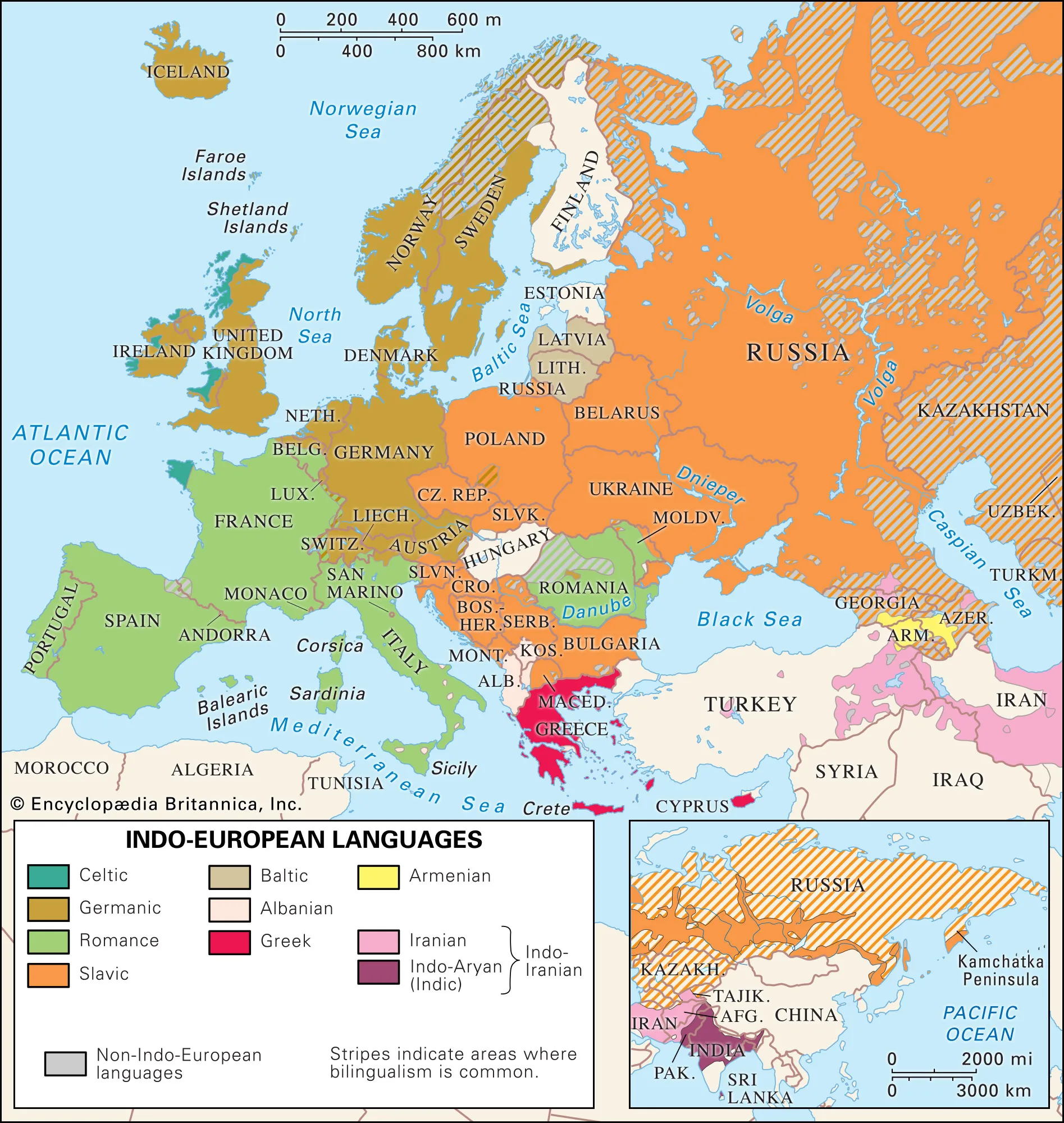 The full Indo-European language family is classically divided into 10 branches.
The 4 branches listed above are the most widely spoken, with each having hundreds of millions of native speakers.
Hellenic, Albanian, Armenian, and Celtic are the remaining live branches, each spoken by under 15 million native speakers. Anatolian and Tocharian are extinct branches.
As you can see on the map, there are alternate ways to classify the Indo-European language family. For example, separate Baltic and Slavic branches can be distinguished; Indo-Iranian can be specified with 2 main subbranches, Iranian and Indo-Aryan; Romance and Italic are terms used interchangably, as are Hellenic and Greek.
Over 3.4 billion people, 42% of the global population, speak an Indo-European language as a first language -- by far the most of any language family. There are about 446 living Indo-European languages, 313 belonging to the Indo-Iranian branch. English, Hindi, Spanish, French, and Bengali are the most widely spoken languages of the Indo-European language family.
Sources: